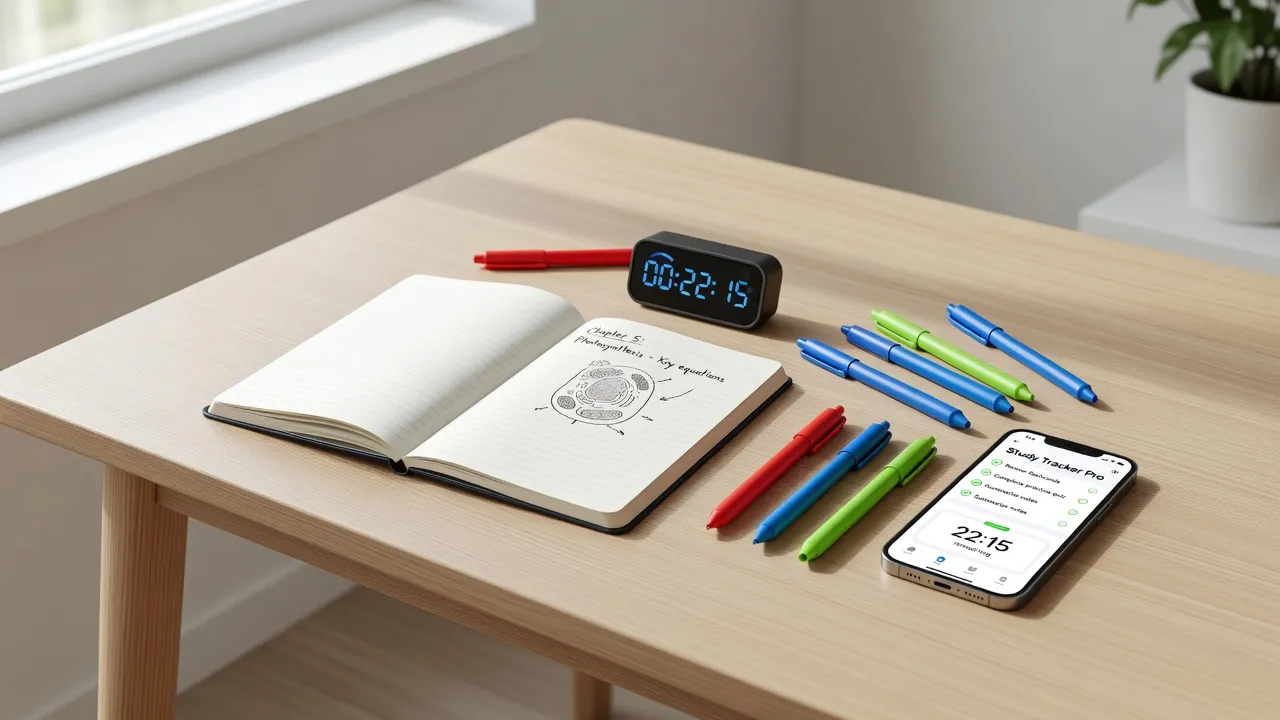
You can build an ADHD-friendly study system that stops task paralysis and improves retention by replacing passive reading with active, low-friction study skills tailored to executive dysfunction. Moving from rigid, neurotypical study schedules to externalized timers, multi-sensory tools, and immediate feedback loops usually takes under an hour to set up.
Traditional study advice fails students with Attention-Deficit/Hyperactivity Disorder (ADHD) because it assumes your brain relies on natural dopamine regulation and strong working memory. According to the National Institute of Mental Health, ADHD is characterized by persistent patterns of inattention, impulsivity, and executive dysfunction that make starting and maintaining focus on low-stimulation tasks exceptionally difficult.
The steps below re-engineer your study environment around how an ADHD brain actually operates.
| Study Step | Realistic Target Time | Mindset or Tool Needed | Hard Requirement / Limit |
|---|---|---|---|
| 1. Externalize Memory | 10 minutes | Whiteboard or index card | Must show only 1-2 tasks at a time |
| 2. Remove Starter Friction | 5 minutes | Timer & plain text pad | Rule out multi-step planning |
| 3. Get Immediate Feedback | 15–30 minutes | ThinkAssist app or answer keys | Stops working memory drop-offs |
| 4. Time Interval Work | 25 minutes | Visual countdown clock | Requires scheduled study break stops |
| 5. Force Active Recall | 20 minutes | Flashcards or teaching out loud | Rules out passive re-reading |
Step 1: Externalize your working memory into a single-task visual display
To stop working memory overload, write down only your current step on a physical whiteboard or index card while hiding the rest of your assignment. The working memory capacity in ADHD brains is lower than in neurotypical peers, meaning holding a 5-step problem in your head causes instant cognitive fatigue.
When you look at a full syllabus or a detailed chapter, your brain views every item as an immediate, simultaneous demand. That overload causes intense overwhelm, which often leads to avoiding the work entirely.
- Hide the big picture: Cover the rest of your textbook page or sheet with a blank sheet of printer paper.
- Write one micro-task: Place an index card next to your keyboard that says only: "Read paragraph 1" or "Solve problem A."
- Clear your digital environment: Close all browser tabs except the exact assignment page.
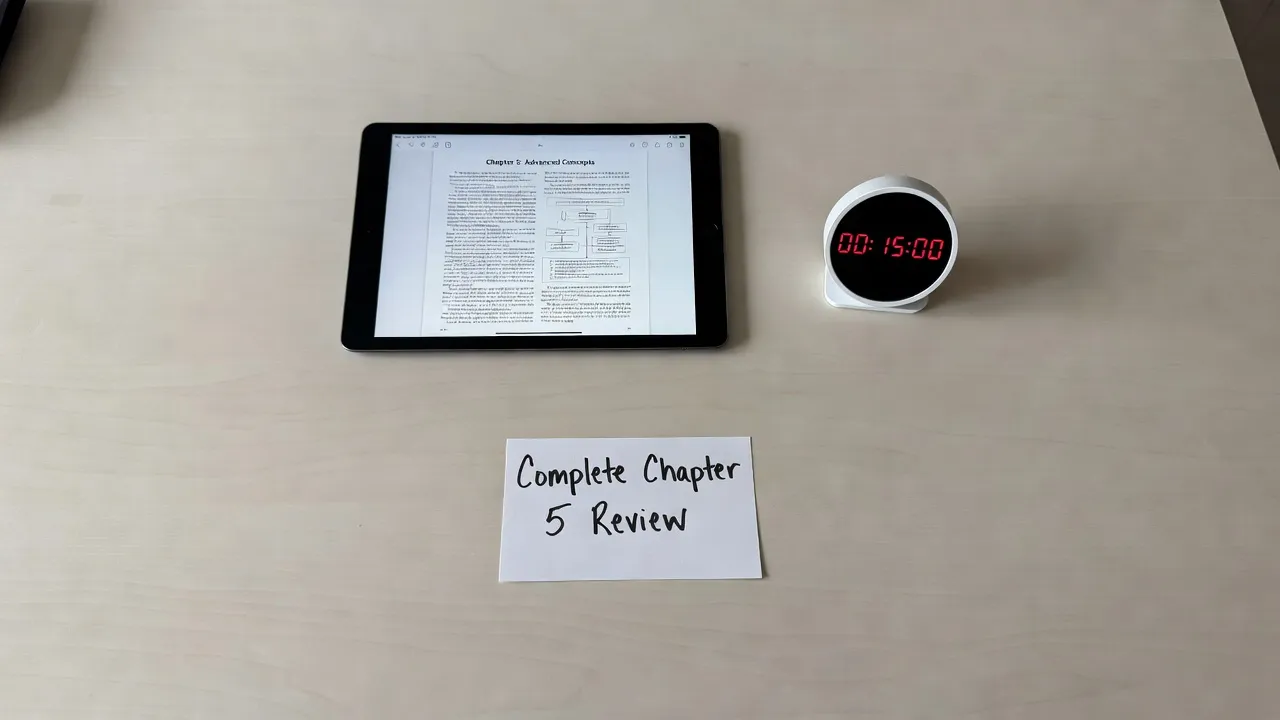
Step 2: Use the 5-minute activation rule to break task paralysis
You break task paralysis by lowering the entry cost of a task until your brain no longer perceives it as a threat. Task paralysis is not laziness; it is an emotional and cognitive blocker caused by low baseline dopamine and poor executive initiation.
When you face a major project, your brain categorizes the total time investment instead of the first motion. If you tell yourself you have to study for three hours, your executive network shuts down.
- Set a timer for 5 minutes: Use a visual countdown timer rather than a standard phone clock so time remaining is physically visible.
- Define the lowest effort start: Decide that you only need to open the document, write your name, or complete one single equation.
- Give yourself permission to quit: Tell yourself honestly that if you want to stop after 5 minutes, you can. In most cases, crossing the initiation barrier generates enough momentum to keep going.
If your task paralysis stems from not understanding complex phrasing, try breaking down the problem visually. For math and science coursework, using an instant guidance tool like ThinkAssist helps by letting you snap a photo of a single problem to get immediate, structured steps. This gets you past the initial panic of staring at a blank page.
Step 3: Use instant-feedback tools to prevent executive stalls
ADHD study sessions stall when you hit a blocker and have to wait for help, so you must use instant-feedback systems to maintain momentum. When a neurotypical student hits a confusing problem, they can often hold their focus while searching through a 50-page textbook. An ADHD brain, however, frequently drops the task entirely when faced with delayed feedback.
Guidance updated by the CDC emphasizes that immediate, clear feedback is essential for managing behavioral and educational challenges in individuals with ADHD. When you hit a roadblock in problem-solving, waiting hours for an email response from an instructor kills your momentum.

To maintain continuous focus without getting stuck:
- Automate problem breakdown: If you are working through complex subjects, snap a photo of the assignment using the ThinkAssist iOS app to view instant, step-by-step explanations.
- Check work incrementally: Solve one problem, verify the logic right away, and correct errors before moving to problem two.
- Avoid delayed grading: Do not complete an entire 20-question sheet without checking if your core method is correct. If your initial logic is wrong, you end up practicing mistakes and frustrating yourself.
If you struggle specifically with quantitative word problems, review strategies on how to solve word problems in math using structured parsing techniques.
Step 4: Swap rigid schedules for high-dopamine interval cycles
Traditional 60-minute study blocks fail ADHD students, so you should use flexible 20-to-25 minute work intervals separated by active movement breaks. Fixed time tables assume steady attention spans. An ADHD brain operates on an interest-based nervous system that thrives on novel, short bursts of intense activity.
The classic Pomodoro Technique (25 minutes on, 5 minutes off) works well, but only if you adjust the break rules, and the right study tracker app with a built-in focus timer can make this easier to stick to. Sitting still during a break scrolling social media gives your brain cheap dopamine, making it nearly impossible to restart work when the timer rings.
- Make breaks physical: Stand up, stretch, grab water, or do quick jumping jacks during your 5-minute break. Physical movement boosts norepinephrine and dopamine levels in the prefrontal cortex.
- Avoid dopamine traps: Do not open short-form video apps or video games during short breaks.
- Use body doubling: Work alongside a classmate or use virtual focus rooms. Knowing someone else is quietly working nearby creates soft social accountability.
When you struggle to get started on written assignments, structure your workspace with a clear reference template, like a 5 paragraph essay writing outline, so you do not spend your timed interval worrying about structural choices.
Step 5: Replace passive reading with active recall techniques
Passive re-reading of notes provides a false sense of fluency while failing to build long-term memory in ADHD students. Re-reading text requires very little cognitive effort, allowing an under-stimulated ADHD mind to wander while eyes keep moving across the page.
Active recall forces your brain to pull information out of memory, creating strong neural pathways and high engagement, a core principle of effective self-study methods.
- The Feynman Technique: Explain the concept out loud in simple terms as if teaching a middle school student. When you hit a gap in your verbal explanation, that marks the exact spot you need to review.
- Blurting Method: Read a single page of notes, close the notebook, and write down every fact, term, and detail you remember on a blank sheet. Open the notebook and use a colored pen to fill in what you missed.
- Flashcard self-testing: Use digital flashcards or physical cards. Always answer out loud before turning the card over.
How do ADHD brains process study materials differently?
ADHD brains process study materials through an interest-driven nervous system rather than an importance-driven one. Knowing an exam is worth 30% of your grade does not automatically release the dopamine required to initiate focus, which is why research-backed testing encouragement strategies can help reduce exam stress.
Executive function deficits impact four major study-related areas:
- Working Memory: Holding multiple steps or complex instructions in mind while performing a task is significantly impaired.
- Time Blindness: Gauging how long a assignment will take or tracking elapsed time visually is extremely difficult.
- Activation: Starting a task that lacks immediate novelty, interest, or urgency triggers internal physical resistance.
- Sustained Attention: Maintaining focus on low-stimulation tasks requires far more glucose and conscious energy than it does for neurotypical peers.
Organizing your workflow around these constraints reduces shame and prevents chronic task delays. Recognizing that putting off work is often a symptom of executive dysfunction rather than poor character helps you pick strategies that actually work.
What should you do when you hit total task paralysis?
When you hit total task paralysis, stop trying to force focus and immediately change your physical state or drop the task requirement to zero. Continuing to stare at a textbook for two hours while feeling guilty burns cognitive energy without producing results.

If you are stuck in a paralysis loop, run this reset protocol:
- Change temperature: Splash cold water on your face or grab an ice cube. Temperature shocks activate the parasympathetic nervous system and break mental rumination.
- Change posture: Leave your desk entirely. Sit on the floor, move to a kitchen table, or try reading while standing up.
- Reduce the task to absurd simplicity: If you cannot read one page, commit to reading one sentence. If you cannot solve a problem set, commit to writing your name on the paper and opening the problem in ThinkAssist to look at the first step.
- Add sensory stimulation: Listen to brown noise, ambient video game soundtracks, or binaural beats to give your brain's background processing something to anchor on without distracting your main focus.
How to set up an ADHD-friendly study station
An ADHD-friendly study space minimizes visual distractions while keeping critical tools directly in your line of sight. Out of sight often means out of mind for ADHD minds, so important items must remain visible without cluttering your immediate desk surface.
Follow these environment design rules:
- Clear visual field: Keep your immediate desk surface completely clear except for the subject you are currently working on.
- Dock your phone outside arms reach: Place your smartphone across the room inside a drawer unless you are using specific, dedicated study tools.
- Use external visual cues: Post your study goals on sticky notes attached directly to the edge of your monitor or lamp stem so your target remains visible when your mind drifts.
- Keep fidget tools accessible: Use silent fidget objects (textured stickers, stress balls) to keep your hands busy during heavy reading tasks.
Frequently Asked Questions
Are study skills different for students with ADHD compared to neurotypical students?
Yes, traditional study skills rely heavily on self-regulation, steady internal motivation, and strong working memory. ADHD-specific study skills focus instead on externalizing steps, reducing entry friction, building short feedback loops, and using high-dopamine interval schedules.
How does time blindness affect studying with ADHD?
Time blindness makes it difficult to sense the passage of time or accurately estimate how long a task will take. Students often underestimate assignment durations or get lost in hyperfocus, which is why visual timers and explicit interval alarms are critical tools.
What is body doubling and why does it help ADHD study habits?
Body doubling is a productivity strategy where you work alongside another person who is also focusing on their own task. The quiet presence of another person creates external structure and gentle social accountability, helping you stay on task without feeling pressured.
Why does listening to music or noise help some people with ADHD focus?
ADHD brains often have lower baseline levels of dopamine. Background noise like brown noise, white noise, or instrumental video game tracks provides a low level of sensory stimulation that keeps the brain's background attention network occupied, preventing it from seeking more distracting diversions.
How can I stop hyperfocusing on the wrong details when studying?
Set explicit checkpoint timers every 15 to 20 minutes to ask yourself if what you are doing is directly tied to your core goal. Writing your primary task on a prominent whiteboard also helps bring your focus back to the main assignment when you catch yourself diving down irrelevant rabbit holes.
Is it better to study on a computer or on paper with ADHD?
Paper is generally better for reading and initial problem solving because digital devices carry high distraction risks like notifications and open tabs. However, for getting immediate feedback or breaking down complex math and science homework, focused digital apps like ThinkAssist offer significant step-by-step guidance advantages.