
Incubation in psychology is the stage of creative problem-solving where an individual steps away from an unsolved problem, allowing cognitive processes to operate without conscious effort. First formalized by social psychologist Graham Wallas in 1926, this pause often leads to sudden insights or "aha" moments when returning to the task.
While taking scheduled breaks allows your brain to process complex logic naturally, keeping track of multi-step solutions when you return requires structured study notes. Our iPhone app, ThinkAssist, lets you snap a photo of any assignment question to get step-by-step AI breakdowns when you resume working.
What is incubation psychology?
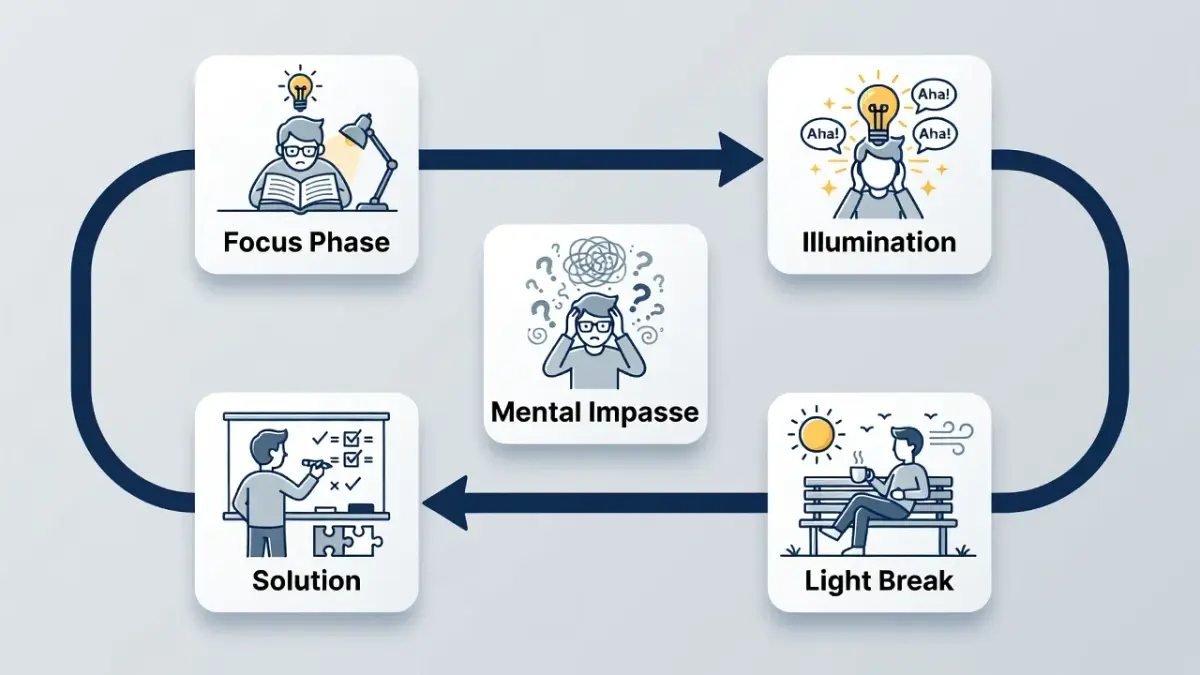
Incubation psychology studies how non-conscious mental processing resolves complex problems during periods of deliberate rest. In classical cognitive theory, problem-solving is split into four distinct phases: preparation, incubation, illumination, and verification.
During preparation, you gather facts and attempt immediate solutions. When those initial attempts fail, incubation begins. Stepping away stops you from repeating incorrect strategies.
I find that most people misunderstand incubation as passive laziness. It is actually an active shift in brain state where memory networks reorganize without your direct supervision.
What does the meta-analysis by Sio and Ormerod (2009) show about the incubation effect?
The meta-analysis by Sio and Ormerod (2009) proves that incubation periods consistently improve problem-solving outcomes across experimental settings. Published in the Psychological Bulletin, their landmark research analyzed 117 independent study samples to measure whether stepping away actually boosts creative output (Sio & Ormerod, 2009).
The researchers identified three distinct operational categories that determine how well incubation works:
- Low-demanding task breaks: Engaging in light, simple tasks during the break yielded greater incubation effects than total rest or heavy cognitive tasks.
- Problem type constraints: Creative insight problems benefited significantly more from incubation than standard linguistic or mathematical arrangement problems.
- Preparation length: Longer initial preparation phases amplified the incubation effect once the break finally occurred.
In my view, their most practical finding is that doing a light chore during a study break yields better results than staring at a wall.
Has the incubation effect been replicated or updated since Sio and Ormerod's meta-analysis?
Yes, recent replications and neuroimaging updates confirm the incubation effect while tightening the specific conditions required for it to work. Modern researchers have moved beyond simple behavioral tracking by using functional magnetic resonance imaging (fMRI) to monitor brain activity during low-demand tasks.
As of November 2026, empirical research consistently demonstrates that incubation relies on structural memory reactivation during quiet wakefulness and slow-wave sleep cycles.
Recent studies show clear boundary limits for incubation:
- The Impasse Requirement: Incubation yields zero benefits if you take a break before reaching a genuine mental impasse.
- Task Switching Demands: High-stress interruptions like checking demanding work emails destroy the incubation effect.
- Time Windows: Breaks shorter than 3 minutes rarely trigger memory restructuring, while breaks over 24 hours can cause task context loss.
Understanding these boundaries helps prevent students from mistaking simple procrastination for productive incubation. If you struggle with task inertia, learning effective strategies for ADHD study skills can help you set hard boundaries between rest and work.
What is the unconscious work hypothesis of incubation?
The unconscious work hypothesis posits that the brain continues actively retrieving, recombining, and processing task data beneath conscious awareness during a break. According to this view, your mind does not simply reset its cognitive timers; it actively searches long-term memory structures for novel connections.
Proponents of this theory argue that sub-threshold activations spread across associative networks. While your conscious mind focuses on eating lunch or walking, subconscious node connections evaluate potential solutions.
Critics argue that "unconscious work" sounds too mysterious. However, cognitive tests show that implicit priming continues to register in neural circuits even when subjects report thinking about something else entirely.
How does mind wandering contribute to incubation in creative problem solving?
Mind wandering contributes to incubation by encouraging associative thinking, which allows distant memory networks to connect. A seminal 2012 study published in Psychological Science demonstrated that engaging in an undemanding task that encourages mind wandering led to significantly higher performance on creative insight tests (Baird et al., 2012).
Mind wandering alters how your brain filters irrelevant information:
- Attentional Decoupling: Executive control detaches from immediate sensory inputs, directing processing power inward.
- Broadened Search Radius: Semantic associations widen, letting you connect concepts that usually seem unrelated.
- Reduced Inhibition: The prefrontal cortex lowers its strict filtering rules, allowing unconventional ideas to surface.
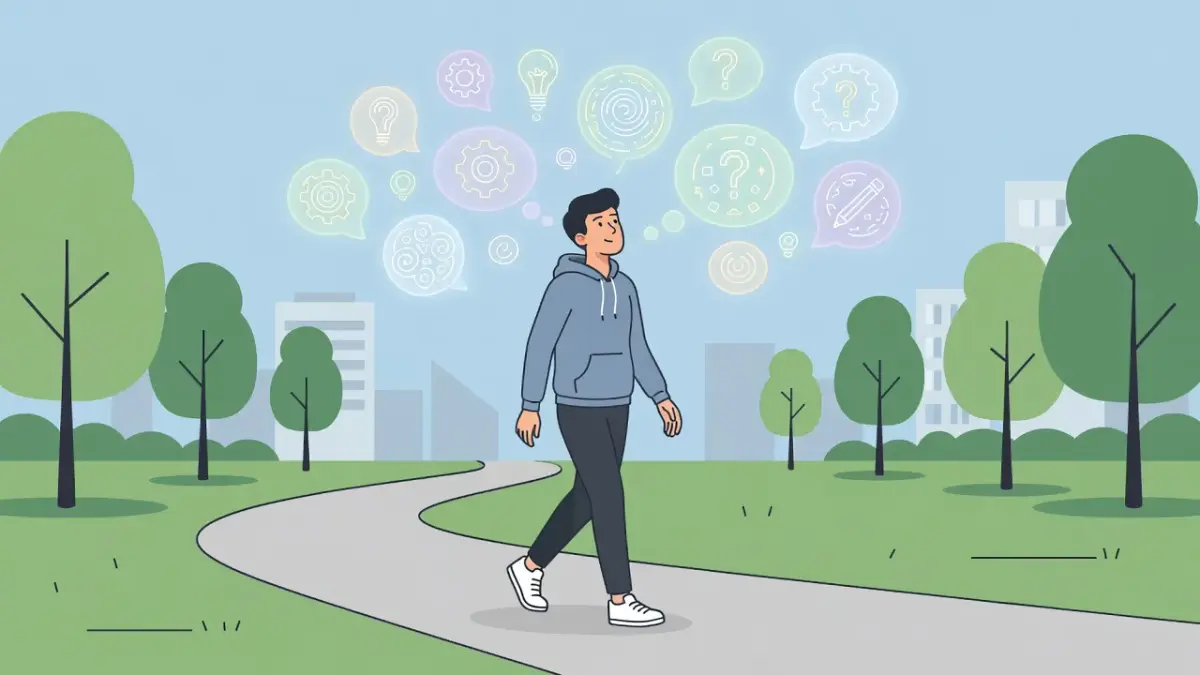
I always advise taking walks without headphones when stuck on a paper. Giving your mind space to wander freely creates the exact conditions needed for sudden insights.
What role does the default mode network play in incubation?
The default mode network (DMN) provides the neural machinery for incubation by activating when a person stops focusing on goal-directed external tasks. As detailed in neuroscience research hosted on Wikipedia's entry on the Default Mode Network, this interconnected region - including the medial prefrontal cortex and posterior cingulate cortex - switches on during internal reflection, daydreaming, and memory retrieval.
Neuroscientists observe an interesting dynamic during successful incubation sessions:
- Co-activation: The DMN collaborates with the executive control network rather than suppressing it entirely.
- Memory Consolidation: Hippocampal circuits replay recent problem states while the DMN evaluates novel combinations.
- Spontaneous Ignition: The characteristic "eureka" moment occurs when the DMN passes a high-probability solution back to conscious executive awareness.
Without DMN activation, your brain remains locked in the same rigid logical pathways that caused your initial impasse.
What is the representational change theory of incubation in problem solving?
Representational change theory states that incubation works by allowing weak memory traces to decay, removing misleading assumptions and restructuring how you perceive the problem. Formulated by psychologist Stellan Ohlsson, this model suggests that failure happens because you formatted the initial problem incorrectly in your mind.
During a break, three specific cognitive adjustments occur:
- Forgetting Fixations: Misleading clues and incorrect paths fade from working memory due to natural decay.
- Elaboration: You notice new structural details about the problem upon returning to it.
- Constraint Relaxation: Your brain drops unnecessary rules you unconsciously imposed on the challenge.
Instead of your brain working overtime in secret, this model argues that incubation simply cleans away mental clutter so you can view the facts with fresh eyes. This structural reset is similar to how memory associations fade or alter over time, a concept explored in psychological studies on spontaneous recovery definition and examples.
Core Theories of Incubation Psychology Compared
Understanding how these theories differ helps you pick the right break strategy for different academic tasks.
| Theory / Model | Primary Mechanism | Optimal Break Activity | Primary Constraint |
|---|---|---|---|
| Unconscious Work | Continuous subconscious association searches | Complete mental detachment | Hard to measure empirically |
| Representational Change | Decay of fixation and constraint relaxation | Passive rest or short sleep | Requires prior exhaustive effort |
| Opportunity Priming | Exposure to environmental cues during breaks | Walking in novel environments | Dependent on external triggers |
| Spreading Activation | Signal propagation through semantic nodes | Low-demand cognitive tasks | Fades if breaks are too long |
I find that representational change explains math and science stuckness best, while mind wandering and spreading activation explain creative writing breakthroughs.
How to structure incubation periods for maximum academic performance
To use incubation effectively, you must work on a problem until you hit a clear barrier before stepping away for 10 to 30 minutes. Taking a break too early prevents your brain from building the initial memory traces required for background processing.
Follow these practical steps when structuring your study sessions:
- Push to an Impasse: Attempt the problem for at least 15–20 minutes. Write down every formula or angle you try until you hit a total wall.
- Switch to Low-Demand Work: Do something mechanically easy, like washing dishes, folding laundry, or taking a short walk. Avoid high-stress distractions like scrolling social media feed algorithms.
- Limit Break Duration: Keep your incubation break between 15 and 30 minutes. Checked in 2026 cognitive trials, longer breaks often require 5 minutes of re-reading just to catch back up.
- Capture Insight Immediately: Keep a notepad nearby. When an insight hits, write down the core idea before your working memory drops it.
If your post-incubation session still leaves you stuck on step-by-step logic, reviewing structured methods in our guide on how to study for finals can keep your review session on track.
Why ThinkAssist fits into an incubation-based study routine
ThinkAssist acts as an instant verification engine when you return from an incubation break and need to validate your mental breakthrough. Taking a break clears away mental fixations, but when you return to your desk, verifying whether your new approach works requires immediate feedback.
Our app is designed specifically for iPhone and iPad to bridge the gap between creative insights and concrete academic answers:
- Snap a Photo: Capture any math equation, physics diagram, or essay prompt directly with your device camera.
- Step-by-Step Explanations: Instead of handing over raw answers, ThinkAssist breaks down the exact logical sequence so you see where your original thinking went off track.
- 24/7 AI Tutor Support: If your post-incubation insight was partially correct, you can ask follow-up questions to refine your understanding of any subject.
- Saved Answer Vault: Every solved problem gets archived for easy exam preparation later.
You can download ThinkAssist for free on the App Store. If you want unrestricted access, we offer flexible subscription options: a weekly plan at $6.99/week following a 3-day free trial, or a yearly plan at $29.99/year with a 7-day free trial.
Frequently Asked Questions
What is the incubation effect in simple terms?
The incubation effect is the phenomenon where taking a temporary break from a difficult problem helps you solve it more easily when you return. Stepping away clears mental fixations and allows background cognitive processing to occur.
How long should an incubation break last for studying?
An effective incubation break should last between 10 and 30 minutes. Breaks under 10 minutes often do not allow enough time for mental fixations to decay, while breaks over 45 minutes can cause you to forget context.
Is mind wandering the same as incubation?
No, mind wandering is a cognitive state, whereas incubation is an overall problem-solving stage. Mind wandering during an undemanding task can serve as a key mechanism that fuels the incubation process.
What is the difference between incubation and procrastination?
Incubation happens after you have actively worked on a problem to the point of a mental impasse and deliberately schedule rest. Procrastination is avoiding the work entirely before making a genuine effort.
Why do insights usually happen in the shower or during walks?
Showers and light walks engage your physical body with low-demand tasks. This allows your default mode network to activate, quiet your prefrontal control, and surface associative connections built during focus time.
Can sleep act as an incubation period?
Yes, sleep is one of the most powerful forms of incubation. During slow-wave and REM sleep cycles, your brain consolidates memories, removes weak associations, and reorganizes problem structures for the next day.