
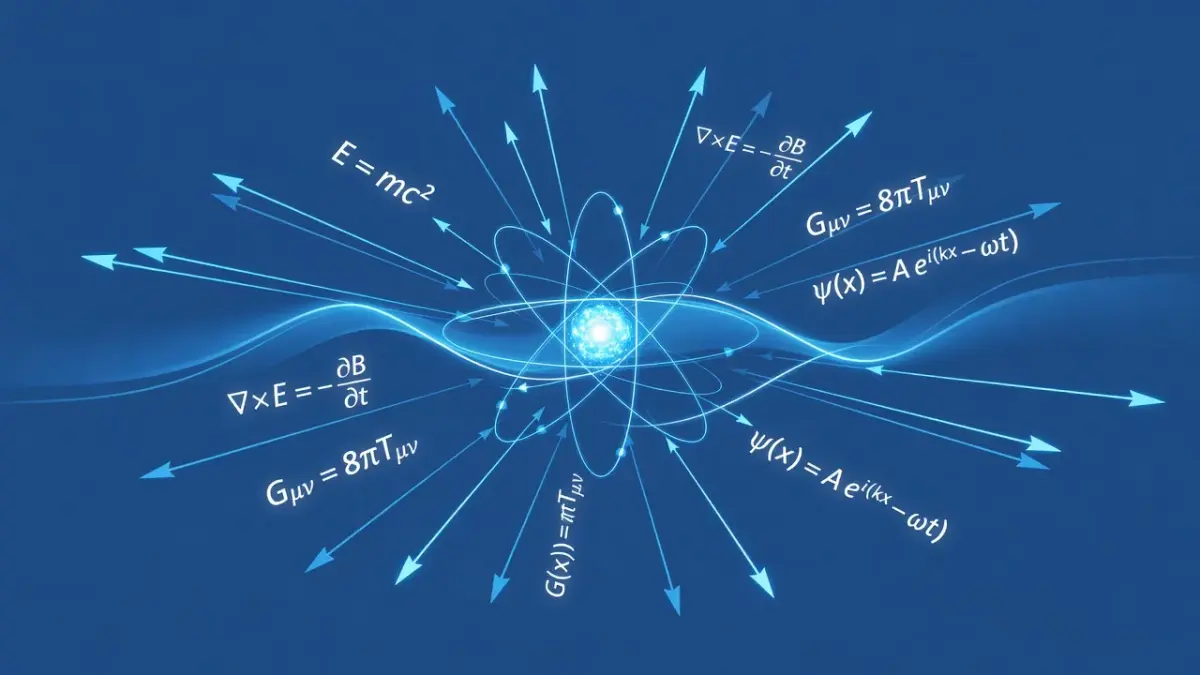
Physics topics span the fundamental study of matter, energy, space, and time, ranging from classical mechanics to modern sub-fields like quantum computing, dark matter detection, and gravitational wave astrophysics. These core areas explain how the universe functions at both macroscopic and subatomic scales. As of October 2026, academic curricula and research agendas emphasize both foundational problem-solving and rapidly evolving experimental physics frontiers.
Mastering these subjects requires a grasp of both conceptual theory and complex mathematical mechanics. Whether you are analyzing force vectors in introductory mechanics or following high-energy collision papers, physics demands a systematic study approach. Tools like ThinkAssist help students parse tough problem sets by converting camera scans of handwritten equations into detailed step-by-step solutions.
What are the latest developments in gravitational waves research (e.g., LIGO)?
Recent developments in gravitational wave research focus on expanding laser interferometer sensitivity, observing continuous gravitational waves, and expanding global multi-messenger astronomy networks. The LIGO Scientific Collaboration and its international partners Virgo and KAGRA have upgraded optical coatings and quantum squeezing techniques. These hardware adjustments allow detectors to pick up sub-surface spacetime ripples from much greater cosmic distances.
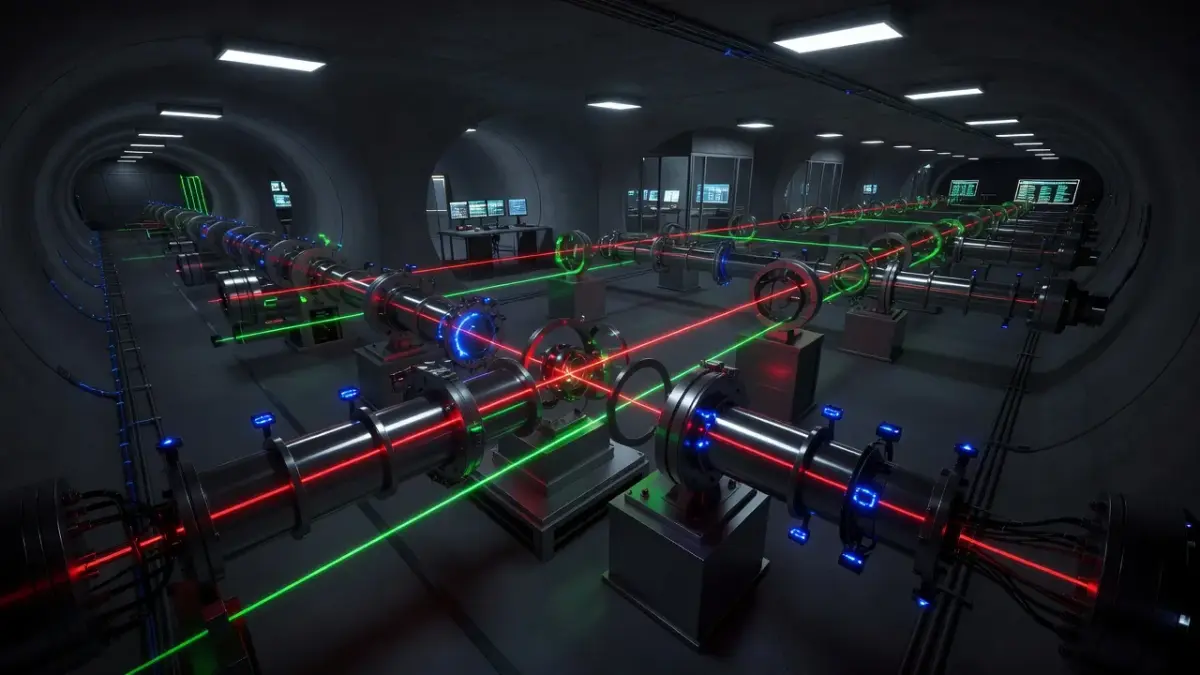
Scientists now capture dozens of compact binary coalescences during every active observing run. Key focus areas include:
- Intermediate-Mass Black Holes: Finding merger events that bridge the gap between stellar-mass black holes and supermassive giants.
- Neutron Star Equation of State: Measuring the precise tidal deformability of merging neutron stars to determine nuclear matter density limits.
- Continuous Waves: Searching for weak, periodic gravitational emissions from asymmetric rapidly rotating neutron stars (pulsars).
These observations give astrophysicists a completely independent channel to observe cosmic collisions that emit no light.
What are the latest developments in dark matter research?
Dark matter research in 2026 centers on ultra-sensitive noble liquid detectors searching for Weakly Interacting Massive Particles (WIMPs) and precision optical cavities hunting lightweight axions. Because dark matter accounts for roughly 85% of all matter in the universe, identifying its particle nature remains a primary challenge in modern astrophysics.
Direct detection facilities use deep underground chambers to shield instruments from background cosmic radiation. Current experimental strategies involve:
- Liquid Xenon Targets: Large-scale experiments like LUX-ZEPLIN (LZ) and XENONnT use tonnes of liquid xenon to catch rare nucleus recoil events.
- Axion Dark Matter Experiments: Projects such as ADMX use high-field superconducting magnets to convert hypothetical axions into detectable microwave photons.
- Effective Field Theory Models: Theorists map dark matter interaction limits across a broader range of candidate masses than previously investigated.
While direct detection of a primary candidate particle remains unconfirmed, these experiments continue to narrow down allowable cross-section parameters.
What are the latest developments in quantum computing and quantum information?
Quantum computing developments in 2026 are dominated by fault-tolerant quantum error correction, logical qubit scaling, and neutral-atom hardware architectures. Researchers have moved past the initial era of noisy intermediate-scale quantum (NISQ) devices into systems that run surface codes to protect logical information.
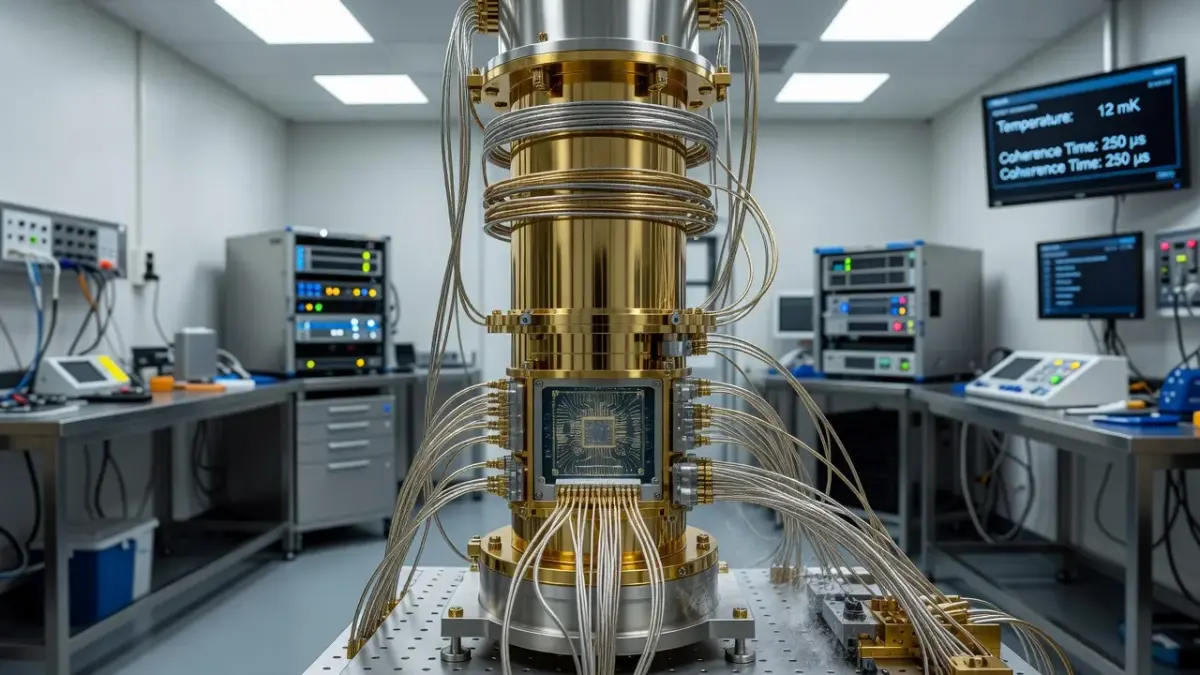
Progress spans both hardware engineering and quantum information software:
- Neutral Atom Arrays: Optical tweezers position individual rubidium or neutral atoms to execute high-fidelity two-qubit gate operations.
- Logical Qubit Realization: Systems bundle dozens or hundreds of physical qubits into single error-corrected logical qubits with extended coherence times.
- Quantum Sensing Standards: The National Institute of Standards and Technology continues to develop quantum-based measurement standards for atomic clocks and magnetometry.
These technical steps move quantum information science closer to practical simulations of complex molecular dynamics and material science problems.
What are the latest developments in topological materials and moiré physics (e.g., graphene, topological insulators)?
Moiré physics and topological material research now focus on twisted multi-layer graphene setups that exhibit fractional quantum anomalous Hall effects and unconventional superconductivity. By stacking two-dimensional atomic layers and twisting them to precise "magic angles," physicists create synthetic superlattices with flat electronic energy bands.
Moiré Superlattice Formation:
[ Graphene Layer 1 ]  -> (Aligned at 0 degrees)
       ||
  [ Twist Angle ~1.08° ]
       ||
[ Graphene Layer 2 ]  -> (Flat bands emerge -> Strong electron correlations)
These flat bands slow electron kinetic energy, allowing strong electron-electron interactions to dominate the material behavior. Major findings in condensed matter laboratories include:
- Skyrmion Lattices: Stable, nanometer-scale magnetic spin textures that can be moved with minimal electrical current for energy-efficient data storage.
- Topological Insulator Interfaces: Materials that act as electrical insulators in their interior but support lossless conducting states along their outer boundaries.
- Majorana Zero Modes: Non-Abelian anyon excitations formed at superconductor-semiconductor boundaries, which are tested for topological quantum computation.
What is the latest progress in fusion energy, including ITER?
Progress in fusion energy as of October 2026 includes major assembly milestones at the ITER facility alongside record plasma stability records achieved by private compact magnetic confinement devices. The international ITER Organization project in southern France continues installing its massive tokamak components, including the central solenoid magnet and vacuum vessel sectors.
Public and private fusion initiatives pursue several distinct confinement designs:
- Magnetic Confinement (Tokamaks and Stellarators): Using powerful superconducting magnets to trap heated deuterium-tritium plasma at temperatures over 100 million degrees Celsius.
- Inertial Confinement: Focusing high-power laser arrays onto fuel pellets to trigger high-yield compression implosions.
- High-Temperature Superconducting Magnets: Utilizing REBCO magnet coils to build smaller, higher-field fusion reactors at lower capital costs.
Engineering teams focus heavily on plasma heat exhaust management and breeding tritium fuel inside reactor blankets.
What are the trending topics and submission statistics on arXiv for physics?
Trending physics topics on arXiv are currently led by quantum machine learning, condensed matter moiré superlattices, and high-energy cosmological phenomenology. The open-access preprint server arXiv.org processes thousands of monthly paper uploads across its physics categories.
| Subject Category | Share of Uploads |
|---|---|
| Condensed Matter (cond-mat) | ~30% |
| High Energy Physics (hep-th, hep-ph) | ~22% |
| Astrophysics (astro-ph) | ~20% |
| Quantum Physics (quant-ph) | ~18% |
| General Physics & Education | ~10% |
Data from preprint logs show strong growth in cross-disciplinary papers. Researchers routinely combine machine learning algorithms with density functional theory calculations to discover new chemical compounds and structural materials.
Foundational Physics Topics: Classical vs. Modern
While cutting-edge physics research grabs news headlines, standard academic coursework builds from foundational classical principles. Physics education breaks down into major distinct subject buckets.
Classical Mechanics and Kinematics
Classical mechanics examines the motion of macroscopic objects under the influence of forces. Key topics include:
- Newton's Laws of Motion: Force balancing, mass acceleration, and action-reaction pairings.
- Conservation Laws: Momentum, energy, and angular momentum conservation in isolated systems.
- Rotational Dynamics: Moment of inertia, torque vectors, and rolling motion without slipping.
Electromagnetism and Field Theory
Electromagnetism analyzes electric charges, magnetic fields, and electromagnetic radiation. Core concepts cover:
- Maxwell's Equations: Gauss's law, Faraday's law of induction, and Ampere's law with Maxwell's addition.
- Circuit Analysis: Resistance, capacitance, inductance, and alternating current (AC) phase angles.
- Electromagnetic Waves: Light propagation, polarization, and wave interference dynamics.
Thermodynamics and Statistical Mechanics
Thermodynamics tracks heat transfer, work generation, and energy state changes. Key principles include:
- Laws of Thermodynamics: Absolute zero temperature limits, energy conservation, and entropy increases.
- Kinetic Theory of Gases: Ideal gas behavior, pressure-volume relationships, and particle velocity distributions.
- Statistical Ensembles: Microcanonical, canonical, and grand canonical system state counts.
How to Study Complex Physics Topics Step-by-Step
Understanding physics requires moving past passive reading into active mathematical application. Students who struggle often try to memorize final equations without learning how those formulas derive from basic principles.

- Draw a Clear Free Body Diagram: Isolate the system under investigation. Label all force vectors, gravitational pulls, normal forces, and friction directions before touching a calculator.
- Identify Knowns and Unknowns: List target variables alongside given values, ensuring all units match standard SI metrics.
- Select the Governing Principle: Determine if the problem relies on energy conservation, force equilibrium, or momentum balance.
- Isolate Variables Algebraically: Rearrange equations to solve for the target variable before inserting numerical values.
- Evaluate Units and Sanity Check: Check that your final expression yields the correct unit dimensions (like Joules or Newtons) and sensible magnitudes.
Students facing difficult conceptual blocks can read our guide on why physics is hard to fix common analytical habits. You can also review our list of basic physics equations to keep core formulas handy during problem sets.
Comparing Physics Learning Tools and Study Resources
Different study resources serve different roles in a student's workflow. Finding the right mix of reference books, problem solvers, and practice sets accelerates exam preparation.
| Study Resource / Tool | Primary Use Case | Step-by-Step AI Explanations | Automatic Subject Recognition | Pricing Model |
|---|---|---|---|---|
| ThinkAssist | Resolving specific physics homework problems and test prep via camera scan | Yes (24/7 AI tutor guidance) | Yes (Identifies mechanics, circuits, thermodynamics) | Free download, 3-day trial, then $6.99/week |
| Standard University Textbooks | In-depth theory reading and fundamental mathematical derivations | No (Static text only) | No | $80 - $250 purchase |
| Digital Solutions Manuals | Checking static answer keys for specific textbook problem sets | No (Fixed text solutions) | No | $15 - $50/month subscription |
| Video Lecture Libraries | Visualizing conceptual overviews and classroom demonstrations | No (Passive media viewing) | No | Free - $20/month |
Using AI Solvers to Master Physics Homework
When stuck on complex multistep physics problems, having a personal tutor available helps prevent hours of frustration. The ThinkAssist App operates as an AI-powered homework solver app designed to support students across all STEM coursework.
Student Physics Workflow with ThinkAssist
- Snap a Photo of Problem
- Automatic Subject Detection, which identifies topic (Kinematics / Optics)
- Step-by-Step Solution Breakdown
- Save Explanation to Past Answers, which is used for future test prep
The app lets you snap a photo of any handwritten or printed physics problem. Its automatic subject detection system recognizes whether the image contains rotational dynamics, wave interference, or circuit loops.
Instead of showing just a final answer, ThinkAssist provides step-by-step explanations so you understand the underlying logical steps. All past solutions save automatically in your account, building a personalized study archive for quick midterms and finals review. If you want to check out comparable digital homework tools, explore our review of the best physics solver apps.
Frequently Asked Questions
What are the main branches of physics topics taught in school?
The primary branches taught in high school and introductory college courses are classical mechanics, electricity and magnetism, waves and optics, thermodynamics, and introductory modern physics.
Which physics topic is generally hardest for students?
Rotational dynamics, electromagnetic field derivations, and thermodynamics entropy problems are widely cited as the most difficult topics because they require advanced vector calculus and abstract conceptual spatial visualization.
How do researchers choose modern physics topics to investigate?
Physicists pick research topics based on unresolved empirical discrepancies, experimental facility capabilities, research grant funding priorities, and theoretical predictions requiring experimental verification.
What is the difference between classical and modern physics topics?
Classical physics deals with everyday speeds and macroscopic scales using Newton's laws and Maxwell's equations. Modern physics addresses subatomic scales and near-light speeds using quantum mechanics and Einstein's theory of relativity.
Are advanced math skills essential for understanding physics topics?
Yes, physics uses mathematics as its foundational language. Algebra and trigonometry are required for introductory courses, while calculus, differential equations, and linear algebra are required for advanced physics topics.
How can an AI solver help with physics homework problems?
An AI solver allows students to take a picture of a problem and receive a step-by-step breakdown of the solution, helping them spot mathematical errors and understand the physical concepts behind each calculation.