

A study cycle is a structured system that divides learning into distinct phases - typically previewing material, focused studying, active retrieval, and performance checking - to maximize long-term memory retention. Unlike passive reading, a study cycle forces your brain to alternate between intense cognitive processing and deliberate rest. While managing study intervals keeps your attention high, keeping track of detailed solutions requires simple organization; for iOS users, our app ThinkAssist captures homework problems via camera and automatically tags solutions by subject for pre-exam review.
What is a study cycle and how does it work?
A study cycle is a five-step learning framework designed by academic support specialists to turn short-term lecture information into permanent knowledge. Originally popularized by the LSU Center for Academic Success, the framework breaks study habits into five distinct actions: Preview, Attend, Review, Study, and Check.
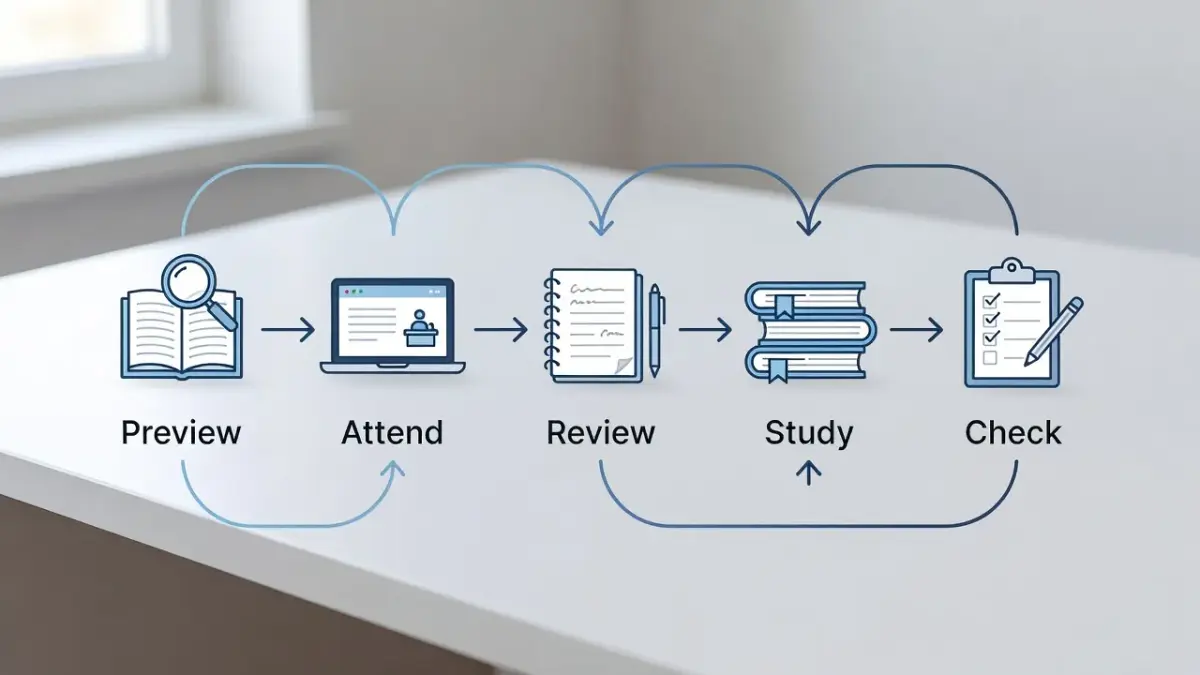
The 5 core stages of the classic study cycle
- Preview: Spend 5 to 10 minutes skimming upcoming chapter headers, formulas, and summaries before class to create mental hooks.
- Attend: Go to class, take active notes, and ask questions while your initial preview context is fresh.
- Review: Spend 5 to 10 minutes right after class reviewing your lecture notes to clarify messy points and fill missing gaps.
- Study: Conduct focused 30- to 50-minute study sessions using active learning techniques rather than passive re-reading.
- Check: Test your knowledge through practice questions or self-quizzing to confirm you actually understand the material.
If you skip the Check phase, you run the risk of false competence - feeling like you understand a concept simply because you recognize it when reading. Building an effective routine around these five steps is a core foundation when learning how to make a study guide before major exams.
How AI homework tools stream into a study cycle
AI homework helpers fit directly into the Study and Check phases of a study cycle by providing immediate feedback when you hit a wall. During focused study sessions, getting stuck on a single math equation or chemistry conversion can stall your entire momentum.
I always tell students that waiting 48 hours for a teacher's office hours breaks the momentum of a daily study cycle. Modern AI tools eliminate that bottleneck by explaining hard concepts mid-session.

Using ThinkAssist for rapid feedback and review
For students on iOS, ThinkAssist acts as an on-demand tutor that keeps your study cycle moving. You snap a photo of any printed or handwritten homework problem, and the app generates step-by-step explanations in roughly 2 to 4 seconds.
- Automatic Subject Organization: ThinkAssist automatically categorizes every solved problem under subject tags. When exam week arrives, your past homework questions exist as a pre-built study guide.
- Step-by-Step Problem Solving: Math equations, fractions, and scientific formulas are formatted clearly, matching standard textbook layouts.
- Follow-up Chat: If a specific solution step seems confusing, you can ask follow-up questions directly in the built-in chat.
- Fair Pricing Model: ThinkAssist is free to download on iPhone and iPad. Weekly access starts with a 3-day free trial followed by $6.99 per week, while annual access offers a 7-day free trial at $29.99 per year (pricing checked November 2026).
Many subscription study tools lock basic history features behind complex $20-per-month tiers. ThinkAssist keeps your full history accessible offline on your device, making pre-test preparation straightforward.
What is the best study session length: 25, 50 or 90 minutes?
The best study session length for most students is 50 minutes, as it provides enough depth for complex reasoning while avoiding mental exhaustion. Choosing between 25, 50, or 90 minutes depends on your current task complexity and cognitive endurance.
Session Length Options: three options branch from this one label.
| Session Length | Name | Best For |
|---|---|---|
| 25 Minutes | Pomodoro | Best for starting, drill work, flashcards |
| 50 Minutes | Standard | Best for problem-solving, essays, STEM |
| 90 Minutes | Ultradian | Best for deep research, coding, writing |
Comparing 25, 50, and 90-minute blocks
- 25-Minute Blocks: Ideal for repetitive tasks, vocabulary drilling, and breaking through heavy procrastination barriers.
- 50-Minute Blocks: The ideal middle ground for university courses, high school STEM subjects, and detailed essay outlines.
- 90-Minute Blocks: Suited for advanced research, complex programming assignments, and deep creative drafting that require long warm-up times.
If your work involves quick formulas, 25 minutes works fine. But if you are solving multi-step calculus problems, a 25-minute timer cuts off your concentration right as your brain enters deep focus.
Is the Pomodoro technique (25 minutes study, 5 minutes break) effective for students?
Yes, the Pomodoro technique is highly effective for students struggling with procrastination, focus drift, and heavy mental fatigue. Developed by Francesco Cirillo in the late 1980s, the technique uses a simple timer to enforce strict work-rest ratios.
Why Pomodoro works for focus
- Reduces Cognitive Strain: Knowing you only need to focus for 25 minutes makes starting intimidating assignments much easier.
- Prevents Mental Burnout: Frequent 5-minute breaks clear accumulated fatigue and maintain steady energy across multiple hours.
- Increases Task Awareness: Tracking completed "Pomodoros" gives clear data on how long specific assignments actually take.
However, the Pomodoro technique has clear limits. If you are mid-thought on an essay, forcing yourself to stop every 25 minutes destroys natural flow. In those cases, taking advantage of incubation psychology mechanisms by stepping away only when genuinely stuck works far better than rigid timers.
Is the 52/17 study cycle effective, and where did it come from?
The 52/17 study cycle is an effective interval routine that originated from productivity data collected by the time-tracking firm DeskTime. Their analysis revealed that the top 10 percent of productive workers focused intensely for 52 minutes followed by a 17-minute complete break from screens.
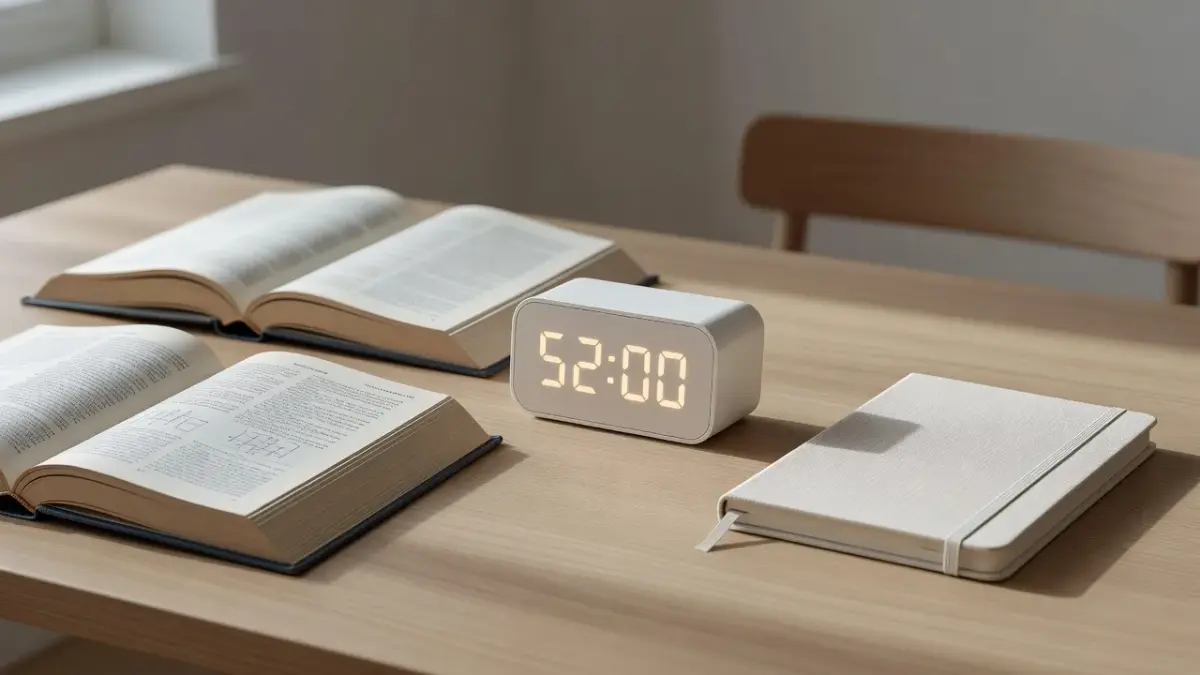
Why 52 minutes of work with 17 minutes of rest works
According to published productivity metrics from DeskTime's research, human attention naturally declines after roughly 50 minutes of continuous strain. The 17-minute break gives your brain enough time to rest fully, which is significantly more refreshing than a brief 5-minute pause.
- Complete Disconnection: Use the 17 minutes to walk, stretch, or grab water - stay away from study materials and social media.
- Higher Peak Performance: The extended rest period allows your brain to reset cognitive capacity for the next 52-minute block.
- Screen Fatigue Protection: Long breaks protect your eyes from digital strain during prolonged study sessions.
Do 90-minute ultradian rhythm study cycles improve learning?
Yes, 90-minute ultradian rhythm study cycles improve learning by aligning work blocks with the body's natural physiological rest-activity cycles. Biological research archived by the National Center for Biotechnology Information confirms that human alertness fluctuates in roughly 90- to 120-minute waves throughout the day.
Tapping into ultradian performance waves
During a 90-minute study cycle, your brain moves through clear cognitive phases:
- Minutes 0-15: Ramp-up phase where focus gradually sharpens.
- Minutes 15-75: Peak cognitive performance and deep mental processing.
- Minutes 75-90: Cognitive drop-off phase marked by increasing distraction and mental friction.
Following a 90-minute study session, you require 20 to 30 minutes of true recovery. Pushing past 90 minutes without rest triggers stress responses, leading to diminishing returns and rapid burnout.
| Study Framework | Work Duration | Break Duration | Best Student Use Case | Common Pitfall |
|---|---|---|---|---|
| Active AI-Enhanced Cycle | 45-50 min | 10-15 min | Solving complex homework with ThinkAssist step-by-step verification | Over-relying on instant answers without working through logic manually |
| Pomodoro Technique | 25 min | 5 min | Vocabulary, flashcard drills, overcoming initial procrastination | Fragmenting deep analytical flow during long essay or math sessions |
| Rule of 52/17 | 52 min | 17 min | Standard college lectures, textbook readings, continuous computer work | Taking low-quality breaks on social media instead of resting your eyes |
| Ultradian Rhythm | 90 min | 20-30 min | Deep analytical problem-solving, coding, research papers | Pushing into exhaustion without taking the required full 20-minute break |
| 50/10 Standard Rule | 50 min | 10 min | High school & university class blocks, daily revision routines | Misjudging break lengths and letting 10-minute pauses drift into an hour |
What are the optimal spaced repetition intervals for a study schedule?
The optimal spaced repetition intervals for a study schedule are 24 hours after initial learning, followed by reviews at 3 days, 7 days, 14 days, and 30 days. Spaced repetition directly counters the human forgetting curve by forcing memory retrieval right as forgotten details drop.
Building a spaced review calendar
Detailed memory research compiled on Wikipedia's spaced repetition breakdown demonstrates that reviewing material immediately before you forget it strengthens long-term neural pathways.
Initial Learning (Day 0) comes first, and five reviews branch below it, listed in order:
| Review | Day | Note |
|---|---|---|
| Review 1 | Day 1 | 24 Hours Later |
| Review 2 | Day 3 | |
| Review 3 | Day 7 | |
| Review 4 | Day 14 | |
| Review 5 | Day 30 | Permanent Retention |
- Review 1 (Day 1): Re-read notes and complete 3-5 practice problems 24 hours after the initial lecture.
- Review 2 (Day 3): Test yourself using flashcards or self-quizzing without checking notes.
- Review 3 (Day 7): Work through mixed practice sets combining new and old topic variations.
- Review 4 (Day 14 & Day 30): Perform quick high-level summary tests to confirm long-term retention.
As of November 2026, modern study workflows integrate spaced repetition with digital organizers. Using dedicated tools listed in our guide to the best study tracker apps makes tracking these staggered review dates automatic.
How do interleaving and retrieval practice fit into study schedules?
Interleaving and retrieval practice fit into study schedules by replacing passive reading with active testing and mixing multiple related topics within a single study session. Rather than spending three straight hours on one math topic (blocked practice), interleaving mixes related topics to build stronger problem-solving flexibility.

Combining interleaving with active study cycles
- Block Practice (Weak): Study Topic A for 3 hours straight.
- Interleaved Practice (Strong): Study Topic A for 45 minutes, switch to Topic B for 45 minutes, then test on Topic C for 45 minutes.
When you interleave subjects during a 50/10 study cycle, your brain constantly discriminates between different problem types. Paired with active retrieval practice - such as solving blank-page practice tests or using camera solvers to verify work after trying it yourself - you build deep exam readiness faster than passive reading ever allows.
Frequently Asked Questions
What is the 5-step study cycle?
The 5-step study cycle consists of Preview, Attend, Review, Study, and Check. It was created by academic specialists at Louisiana State University to help students move course information from short-term memory into long-term understanding through daily practice.
How long should a student study cycle be?
For most students, a 50-minute study session followed by a 10-minute break offers the ideal balance. However, high-intensity memory work like vocabulary flashcards works better in 25-minute Pomodoro sessions, while complex research papers suit 90-minute ultradian blocks.
Is taking breaks during study cycles really necessary?
Yes, taking planned breaks is essential for memory consolidation and cognitive recovery. Continuous studying without breaks leads to mental fatigue, elevated stress hormones, and a steep drop in long-term information retention.
Can high school students use the same study cycles as college students?
Yes, the core mechanics of study cycles work across all age levels. High school students often benefit from starting with shorter 25-minute Pomodoro intervals, while college students usually require 50- or 90-minute blocks to handle longer reading loads and complex problem sets.
How do I stop procrastinating at the start of a study cycle?
Reduce your entry barrier by promising to study for just 5 minutes using the Pomodoro technique. Lowering the initial commitment reduces task aversion, making it much easier for your brain to build focus momentum.
Should I use social media during study breaks?
No, scrolling social media during study breaks causes cognitive interference and leaves your brain feeling unrefreshed. Use study breaks to walk, stretch, drink water, or look away from screens so your focus can fully recover.
How many study cycles should I complete in a single day?
Most students reach their maximum productive output after three to four 50-minute study cycles per day (roughly 3 to 4 hours of total deep work). Pushing past four intense cycles often leads to diminishing returns and severe fatigue.